
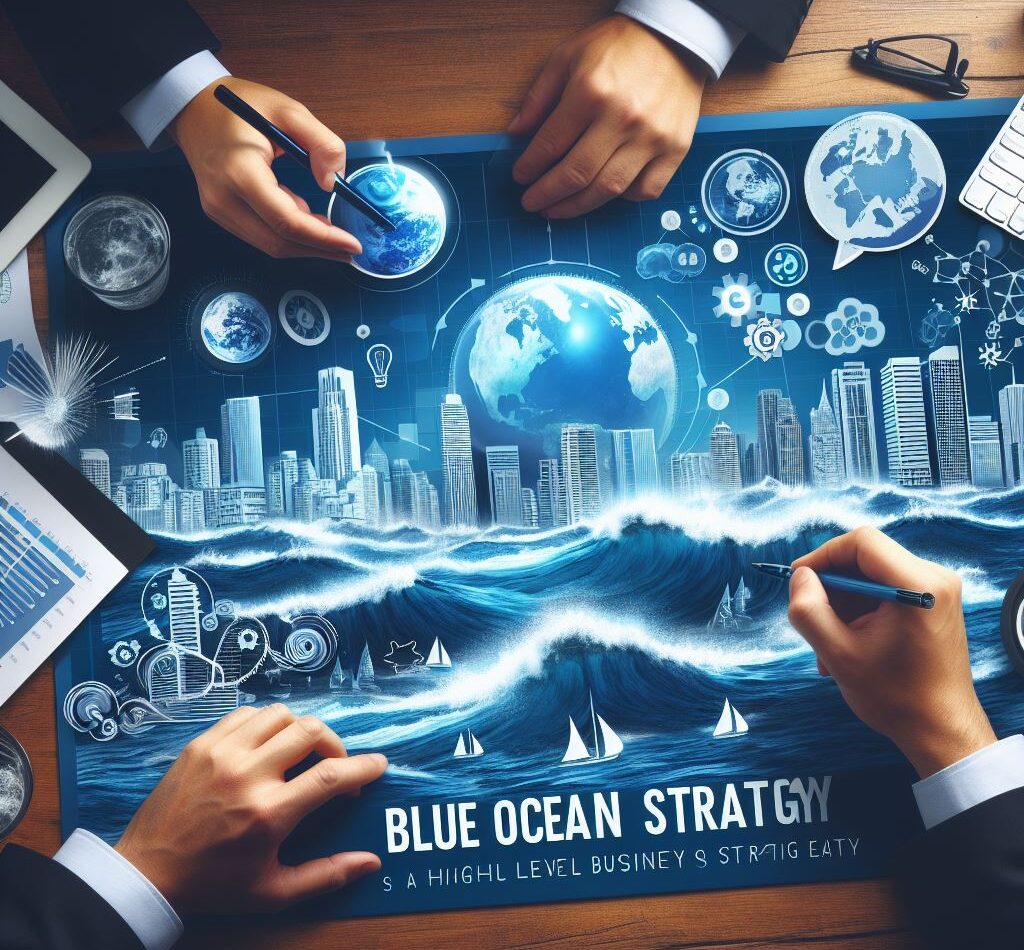
The year 2024: Election year for Sri Lanka and Blue Ocean Strategy

Sri Lanka is in a situation in which all stakeholders should have some collective agenda by looking at the “big picture”. More interestingly the year 2024 will be an election year and we as citizens are not expecting the same sort of “red-ocean-cutthroat” political campaign/s and it should be a “Blue Ocean Strategy” by considering the future of the country
Sri Lanka is still experiencing an economic crisis. The effect of the crisis can be seen in terms of many hardships for common people as survival can be considered as the challenge. The country has again decided to go for the International Monetary Fund (IMF) which has cleared the second tranche of about $ 337 million recently. “Is Sri Lanka getting IMF” is one of the key searches on Google these days. It is unfortunate to see that the country is running out of all options and proceeds with loans. This can be seen as the trend in the last six to seven decades.
Even though the IMF facility will provide us short-term solution and boost international confidence in our economy, Sri Lanka should think about sustainable strategies. This is a must and the country needs entrepreneurial orientation embedded in our economic policy. Universities should produce entrepreneurs, not graduates. Anyway, the year 2024 is already important for Sri Lanka as the year of elections. The election manifesto of any political party should be concerned about sustainable solutions for the country. And also there should be a proper analysis of strategies adopted by political parties to win the election. By analysing the history of Sri Lankan political activities, it is important to discuss about Blue Ocean Strategy as one of the potential strategies for main stakeholders in the political arena.
What is Blue Ocean Strategy?
Usually in business (this is the same in politics as well) you are always concerned about cutthroat competition. It means simply you follow some strategies (most of the time some conventional strategies) to compete in the market. The organisation simply wants to face intense competition in the market. All competitors are practicing similar strategies to obtain something from a given market share. This we called as “Red Ocean Strategy”. As per Chan Kim and Renée Mauborgne (Chan Kim and Renée Mauborgne are notable figures in the field of business strategy, most famous for their development of the Blue Ocean Strategy concept) “Red oceans are all the industries in existence today – the known market space, where industry boundaries are defined and companies try to outperform their rivals to grab a greater share of the existing market. Cutthroat competition turns the ocean bloody red. Hence, the term ‘red’ oceans (Kim and Mauborgne, 2005)”.
In politics and engaging with the general public we can see the same strategies such as book donations, street protests, and meetings conducted. Anyway, political parties should be concerned with applying creative tactics for different market segments such as “floating votes” and “people who did not vote” for elections. Usually in Sri Lanka we can witness 15-20% floating votes and in the year 2019 Presidential election around 16% were not polled (even in the 2020 General election around 24% of people were under the category of “not polled”). There should be different strategies to understand the aforementioned segments in the market. The concept of segmentation always plays a critical role in political marketing. In that context, we should discuss the concept of the “Blue Ocean Strategy”. In Blue Ocean, we are always concerned about uncontested market space. In blue oceans, demand is created rather than fought over. There is ample opportunity for growth that is both profitable and rapid. In Blue Oceans, competition is irrelevant because the rules of the game are waiting to be set.
Implications of Blue Ocean in political landscape
As mentioned in the Blue Ocean Strategy you need to create demand. This is a really important and interesting strategy for all political parties to target floating votes and to target a certain percentage of people who did not poll. And more importantly, with different approaches such as entrepreneurship movements in the country and some positive collaborative work targeting the economy and children even you can target different segments such as partisan voters as well. What we need to understand is the voting behaviour of generations such as Baby Boomers, X, Y and Z Generations.
Baby Boomers, X, Y, and Z refer to distinct cohorts of people born in different time periods. Each generation is characterised by unique experiences, cultural norms, values, and attitudes shaped by the socio-economic and political events of their formative years. There should be more research should be conducted on this as well. Refer following for attributes of Generation Z.
Attributes of Generation Z
Time period: Born from the mid-to-late 1990s through the early 2010s (by looking at this from the year 1990 to 2005 can be considered as segment with voting power).
Characteristics: True digital natives, having been exposed to the internet, social networks, and mobile systems from a young age. They tend to be more tech-savvy and connected.
Values and Attitudes: They are often seen as more pragmatic, analytical, and socially conscious, with a strong concern for mental health and environmental issues.
Cultural and global awareness: Growing up in a hyper-connected world, Gen Z is generally more attuned to global issues and diverse cultures.
Creating a “Blue Ocean” political strategy for Generation Z involves identifying and capitalising on new market opportunities that appeal specifically to this young, tech-savvy, and socially conscious generation. The plan for education policy targeting youth with digitalisation, Loan schemes for needy people (for example: Students studying at universities like The Open University of Sri Lanka) with specific Key Performance Indicators (KPIs) should be embedded with some action-oriented programs that can be conducted before election as well(provocative strategies).There should be intensive studies to be conducted to understand different patterns and behaviours of different cohorts (like Generation X,Y, Z, etc.) and their dynamics.
Conclusion
As mentioned earlier Sri Lanka is in a situation in which all stakeholders should have some collective agenda by looking at the “big picture”. More interestingly the year 2024 will be an election year and we as citizens are not expecting the same sort of “red-ocean-cutthroat” political campaign/s and it should be a “Blue Ocean Strategy” by considering the future of the country.
(The writer is a Professor in Management Studies at the Open University of Sri Lanka. You can reach him via nabey@ou.ac.lk.)