Insights from the World Economic Forum’s Annual Meeting of the New Champions 2025
By Niroshana De Silva, Author, Admin
China’s Geopolitical Chess Game: Strategic Adaptation in an Era of Global Fragmentation
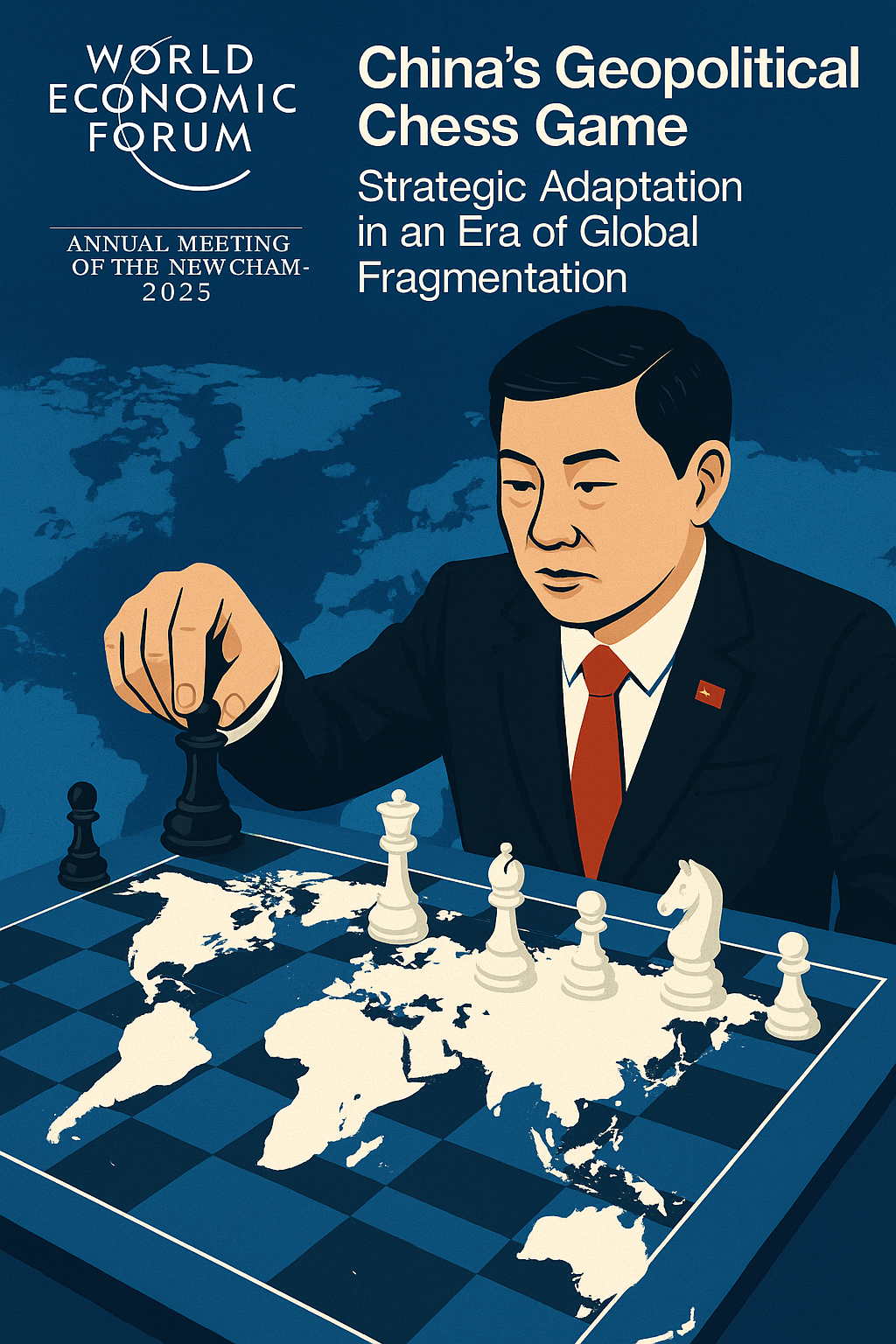
The geopolitical landscape is undergoing a seismic shift, and China finds itself at the epicenter of this transformation. The World Economic Forum’s Annual Meeting of the New Champions 2025 featured a key session on “Geopolitics: An Unfolding Story”, which illuminated China’s sophisticated approach to navigating an increasingly fragmented global order. The revelations from this gathering of world leaders paint a picture of a nation strategically repositioning itself for a new era of international relations.
The Great Economic Pivot: From Export Dependency to Domestic Innovation
China’s geopolitical strategy begins with a fundamental economic transformation. The country is orchestrating a deliberate shift from its traditional infrastructure and export-dependent model toward what officials term “high-quality growth.” This transition, known as the “dual circulation” model, represents more than mere economic policy—it’s a geopolitical masterstroke designed to build self-sufficiency while maintaining global market access.
The implications are profound. By prioritizing domestic consumption, advanced manufacturing (particularly in electric vehicles and renewables), and AI-driven innovation, China is creating a buffer against external economic pressures while positioning itself as indispensable to global supply chains. This strategic rebalancing allows Beijing to weather potential trade wars while maintaining its competitive edge in emerging technologies.
Green Technology: The New Battleground
Perhaps nowhere is China’s strategic thinking more evident than in its approach to green technology. The country has positioned itself as a climate solution provider, leveraging its expansive EV ecosystem and renewable energy supply chains. Companies like CATL are pioneering “EIVs” (intelligent electric vehicles) that emphasize software intelligence, demonstrating how China is moving beyond simple manufacturing to become a leader in next-generation automotive technology.
This green tech dominance serves multiple geopolitical purposes. It aligns with global climate goals, providing China with moral authority in international forums. Simultaneously, it reduces the country’s dependence on fossil fuel imports, which officials view as a “massive national-security multiplier.” By controlling critical elements of the global energy transition, China creates new forms of leverage in international relations.
AI Sovereignty: The DeepSeek Revolution
The recent breakthrough of the DeepSeek AI model exemplifies China’s determination to achieve technological sovereignty. Despite facing Western export restrictions on advanced semiconductors, China has demonstrated remarkable innovation in AI development. The DeepSeek model’s low-cost training breakthrough represents a paradigm shift that could fundamentally alter the global AI landscape.
This technological independence has immediate geopolitical implications. As one industry leader noted, China’s manufacturing technology is now “top notch,” suggesting that the country has successfully upgraded its industrial base despite external pressures. This AI sovereignty reduces China’s vulnerability to Western tech restrictions while potentially creating new competitive advantages in global markets.
The Art of Multilateral Engagement
China’s approach to international relations reflects what might be called “selective multilateralism”—a strategy that combines assertive industrial policy with calibrated global engagement. This approach was prominently displayed when Vice Premier Ding Xuexiang pledged wider market access at the 2025 World Economic Forum, announcing tariff reductions to 7.3% and opening sectors like telecommunications to foreign investment.
This rhetoric of openness serves a specific geopolitical purpose: framing China as a defender of globalization amid rising U.S. protectionism. By positioning itself as the more reliable partner for international business, China seeks to exploit fractures in the Western alliance while building alternative coalitions.
Regional Realignment: The Global South Strategy
China’s regional engagement strategy reveals sophisticated geopolitical thinking. The country has cultivated “pragmatic partnerships” with ASEAN nations, African countries, and other Global South partners. This approach gained validation when Malaysia’s Prime Minister Anwar Ibrahim publicly questioned Western pressure to “single out China,” reflecting growing regional resistance to U.S.-led decoupling efforts.
This regional strategy serves multiple functions. It provides China with alternative markets and investment destinations, reduces its dependence on Western economies, and creates diplomatic leverage in international forums. By offering infrastructure loans and technology transfers without the political conditionality often associated with Western aid, China presents itself as a more attractive partner for developing nations.
Institutional Innovation: Beyond the Western Order
China’s promotion of alternative international institutions like BRICS and bilateral critical-mineral agreements represents a long-term strategy to reshape global governance. Rather than directly challenging existing institutions, China is building parallel structures that operate according to different rules and priorities.
This institutional innovation is particularly evident in China’s approach to critical mineral supply chains. Through bilateral agreements with African and Latin American partners, China is creating alternative pathways for accessing essential resources, reducing its vulnerability to Western-controlled supply chains while increasing other nations’ dependence on Chinese markets.
Navigating the New Cold War
The relationship between China and the United States remains the defining axis of contemporary geopolitics. China’s approach to this great-power competition reflects a nuanced understanding of both the opportunities and constraints of the current moment.
De-risking Without Decoupling
Chinese strategists have embraced the concept of “de-risking without decoupling”—seeking to reduce vulnerabilities while maintaining beneficial economic relationships. This approach recognizes that complete economic separation from the West would be costly and potentially counterproductive. Instead, China seeks “peaceful coexistence” while preparing for prolonged rivalry.
This strategy manifests in China’s approach to technology supply chains. Rather than completely severing ties with Western technology, China is pursuing “friendshoring” strategies that diversify its supplier base while building domestic capabilities. This approach allows China to maintain access to global markets while reducing its exposure to potential restrictions.
The Taiwan Question: Economic Interdependence as Stabilizer
The Taiwan issue remains a potential flashpoint in U.S.-China relations, but economic interdependence continues to moderate escalation risks. Despite increasing military activity near Taiwan, the continuation of practical economic relationships—including LNG trade—suggests that both sides recognize the costs of confrontation.
This dynamic illustrates a broader pattern in China’s geopolitical approach: using economic integration as a tool for managing political tensions. By making confrontation economically costly for all parties, China creates incentives for peaceful resolution of disputes.
Adapting to Trump 2.0
China’s strategic planners are preparing for a more “transactional” U.S. policy under the current administration. This preparation includes contingency plans for leveraging divisions within the U.S. alliance system and positioning China as a stability anchor amid “volatile geopolitics.”
The Chinese approach to U.S. tariffs exemplifies this adaptive strategy. Rather than simply retaliating, China has responded by subsidizing exports in green technology sectors, effectively using trade tensions to accelerate its transition to high-value industries while maintaining market share in strategic sectors.
The Contradictions of Chinese Strategy
Despite its sophistication, China’s geopolitical approach contains inherent contradictions that create both opportunities and vulnerabilities.
The Security-Openness Paradox
China’s simultaneous pursuit of economic openness and security control creates tensions that strain international trust. While promoting global trade and investment, China maintains strict domestic controls on internet governance and exercises growing oversight of overseas ventures, particularly in critical mineral acquisitions.
This paradox reflects a fundamental challenge in Chinese strategy: how to remain sufficiently open to benefit from global integration while maintaining the control necessary for political stability and national security. The tension between these imperatives creates uncertainty for international partners and potential vulnerabilities for Chinese policy.
Structural Economic Challenges
China’s economic transformation faces significant structural obstacles. Weak domestic consumption, reflected in high household savings rates and “anaemic consumption” levels, creates ongoing dependence on exports just as trade barriers are rising. This dependence makes China vulnerable to external economic shocks and limits the effectiveness of the dual circulation strategy.
These challenges require China to balance short-term economic needs with long-term strategic objectives, potentially creating tensions between economic efficiency and political control.
Climate Leadership and Contradictions
While China leads in renewable energy deployment, it faces criticism for coal plant reactivations and controversial water management policies in transboundary rivers. These contradictions highlight the gap between China’s climate rhetoric and its practical policies, potentially undermining its soft power credentials.
The Future of Chinese Geopolitics
The insights from the World Economic Forum’s 2025 meetings reveal a China that is both confident and cautious, assertive and adaptive. The country’s “selective multilateralism” represents a sophisticated response to global fragmentation, combining industrial upgrading with diplomatic innovation.
China’s strategy of promoting green technology exports while building South-South cooperation networks offers a pathway to counter U.S. containment efforts without falling into Soviet-style isolation. However, the success of this approach depends on China’s ability to balance openness with control—a duality that continues to fuel skepticism in Western capitals.
As the geopolitical landscape continues to evolve, China’s approach offers important lessons about adaptation in an era of great-power competition. The country’s emphasis on economic transformation, technological sovereignty, and institutional innovation provides a blueprint for how middle powers might navigate between competing blocs.
The ultimate test of China’s geopolitical strategy will be whether it can maintain its economic dynamism while building the international partnerships necessary for long-term prosperity and security. The early evidence suggests that China is well-positioned for this challenge, but the path forward remains fraught with contradictions and uncertainties.
In an era of global fragmentation, China’s geopolitical approach represents both a response to current challenges and a potential model for future international relations. As the story continues to unfold, the world will be watching to see whether China’s strategic gamble pays off or whether the contradictions in its approach ultimately prove unsustainable.
This analysis is based on insights from the World Economic Forum’s Annual Meeting of the New Champions 2025, where global leaders gathered to discuss the evolving geopolitical landscape and its implications for international business and governance.