

What the Buddha Taught About Financial Management
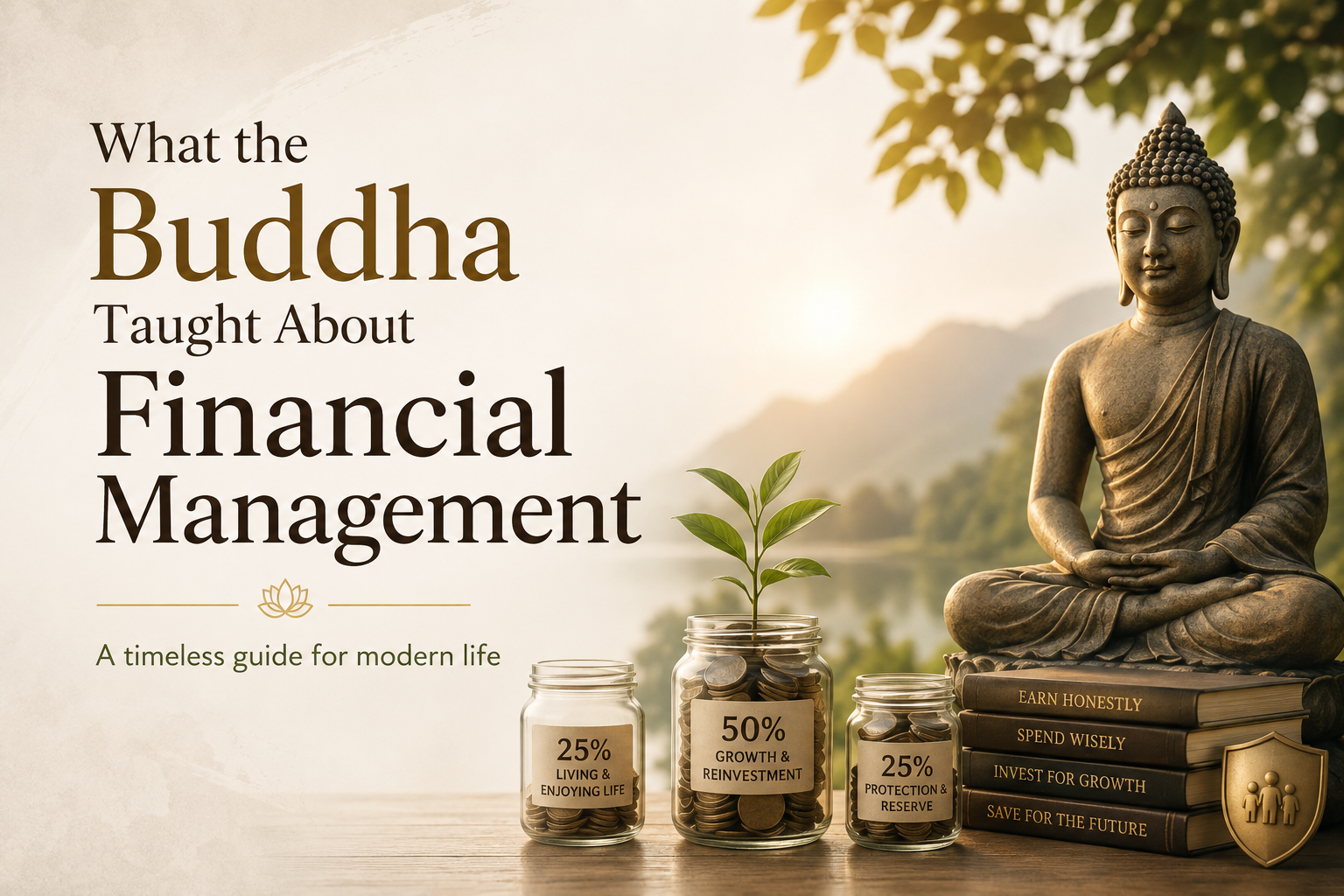
What the Buddha Taught About Financial Management
A timeless guide for modern life
Financial stress has become one of the defining anxieties of modern life. Rising living costs, debt, healthcare bills, and the constant pressure to save for retirement make money one of the heaviest things we carry. What surprised me, the more I read into it, is that this isn’t a new problem — and some of the clearest advice on it is over 2,500 years old.
The Buddha is remembered mostly for teachings on suffering and liberation, but he also gave very practical guidance on running a household and managing money. Most of it comes from a single discourse: the Sigalovada Sutta, sometimes called the “Householder’s Code of Discipline.” It was delivered to a young man named Sigala, whose father had asked the Buddha to give his son some practical direction for life — not abstract philosophy, just usable advice.
The Fourfold Budget
Buried in that discourse is a remarkably specific piece of financial advice. The Buddha taught that a person should divide their income into four equal parts: one part for living and enjoying life, two parts reinvested into work or business, and one part set aside for harder times. In percentage terms, that’s a 25 / 50 / 25 split — and it holds up surprisingly well as a modern budgeting framework.
25% — Living and enjoying life
This portion covers your actual life: food, housing, healthcare, your children’s education, supporting parents or dependents, and a reasonable amount of charitable giving. The Buddha wasn’t advocating extreme frugality here — the teaching is explicitly about moderation and responsible enjoyment of what you earn, not deprivation.
50% — Growth and reinvestment
The largest share goes back into activities that generate future income — expanding a business, investing, or developing a skill that increases your earning potential. The underlying principle: your income shouldn’t just fund your current life, it should build your future one. In modern terms, that’s entrepreneurship, market investing, or deliberate skill-building.
25% — Protection and reserve
The final quarter is kept untouched, as protection against the things you can’t plan for — illness, job loss, an economic downturn, or simply old age. Today this looks like an emergency fund, retirement savings, and health or life insurance. The Buddha treated uncertainty as a given, not a worst-case scenario — preparing for it was simply wisdom, not pessimism.
What makes this framework hold up today is that it’s built around balance rather than any single virtue. Most financial advice leans hard in one direction — spend less, invest more, save aggressively. This teaching asks you to do a bit of all three at once: enjoy today, grow tomorrow, and protect against whatever comes next.
What Quietly Erodes Wealth
The same discourse also names the habits that undo financial security, regardless of how much someone earns. The original list is specific: drinking to excess, wandering the streets late at night, frequenting entertainment to the point of distraction, gambling, keeping company with people who encourage bad decisions, and plain idleness.
None of these require a 2,500-year-old text to recognize — they’re the same patterns that quietly drain people’s finances today. The point the Buddha was making is one that still holds: earning well and protecting what you’ve earned are two different skills, and most financial collapse comes from neglecting the second one. A single medical emergency or bad year can undo a decade of saving if there’s no reserve and no restraint.
Final Thoughts
This was never a teaching about getting rich. It’s a teaching about building a life that’s balanced, responsible, and reasonably secure — something closer to peace of mind than to wealth itself.
Earn honestly. Spend wisely. Invest for growth. Save for the future. Protect what you’ve built.
Financial freedom was never about how much you earn — it’s about how well you manage, grow, and protect it. More than two millennia later, that’s still about as practical as financial advice gets.
Source note: the fourfold-division teaching and the six wealth-eroding habits both come from the Sigalovada Sutta (Dīgha Nikāya 31), “The Layperson’s Code of Discipline.” Translations are available via Access to Insight (accesstoinsight.org).