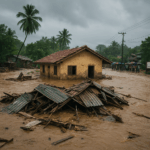
Sri Lanka has endured multiple catastrophic natural disasters in recent decades — each teaching painful lessons about vulnerability, preparedness, and the cost of inaction. The latest shock comes from Cyclone Ditwah, which struck the island in late November 2025, leaving a trail of destruction that will shape the nation’s future.
According to a World Bank Group assessment, the cyclone inflicted an estimated US$4.1 billion in direct physical damage equivalent to roughly 4 % of Sri Lanka’s GDP. Nearly 2 million people across all 25 districts were affected, with roads, bridges, railways, water networks, homes, farms, schools and health facilities heavily damaged or destroyed. The hardest hit was Kandy District, suffering close to US$689 million in damages, primarily from flooding and landslides.
Lives Lost, Communities Shattered
Beyond economic figures lies the tragic human toll. Hundreds of lives were lost, families displaced, and livelihoods wiped out. Floods and landslides submerged fields, eroded villages built along rivers and in flood plains, and left communities struggling to access basic services. Agriculture the backbone of rural livelihoods saw croplands washed away, livestock lost, and food security brought to the brink.
These impacts ripple beyond the immediate disaster: children out of school, businesses closed, elderly and disabled left without support, and long-term nutritional and economic stress deepening poverty in already vulnerable regions.
Learning from the Past: The Tsunami Reconstruction Experience
Sri Lanka’s experience with the 2004 Indian Ocean tsunami offers crucial lessons about disaster response, recovery and resilience building. That unprecedented event claimed around 35,000 lives, destroyed more than 110,000 homes, and left 250,000 families without means of support.
International support, including a substantial World Bank recovery programme, helped rebuild infrastructure, restore livelihoods, and support housing reconstruction. More importantly, it highlighted key principles for effective disaster response:
Strong local governance and community participation are essential for effective recovery and ownership.
Clear communication and social mobilisation strengthen trust and participation in rebuilding efforts.
Operational guidelines and coordinated roles among partners improve accountability and effectiveness.
Reconstruction must be people-centred, transparent and resilient, with a focus on future hazard risk reduction.
These lessons remain deeply relevant today: rebuilding must not simply restore what was lost, but must transform communities to withstand future disasters.
What the Ditwah Damage Reveals About Our Vulnerabilities
The World Bank’s rapid damage assessment underscores how existing socio-economic vulnerabilities amplified the impact of Cyclone Ditwah. Poor households, older persons, women-headed families, and those with limited services suffered disproportionately. Damaged infrastructure severed access to markets and services, highlighting the fragile nature of assets that underpin everyday life.
This disaster also exposed gaps in disaster risk management, early warning systems, land-use planning, water management and resilient infrastructure design areas that require urgent reform if Sri Lanka is to break the cycle of repeated loss.
A Call to Action: Prioritising Disaster Preparedness and Risk Management
Sri Lanka must now place disaster management and climate risk reduction at the core of national governance. Natural hazards intensified by climate change pose existential risks to a nation already vulnerable to monsoons, cyclones, floods, landslides, and drought.
Here’s what must be prioritised:
1. Institutionalise Disaster Risk Management
Disaster preparedness should be anchored in ministerial functions, with clear mandates, accountability and funding. Disaster risk reduction must sit alongside national security, economic planning and social development as a core government priority.
2. Strengthen Early Warning and Communication Systems
Predictive meteorological models should trigger actionable, widespread warnings with sufficient lead time, reaching communities via multiple channels from mobile alerts to radio and community networks.
3. Resilient Infrastructure and Land-Use Planning
Roads, bridges, water systems, schools and hospitals must be engineered to withstand extreme events. Land-use policies must discourage settlement in high-risk zones and promote natural buffers such as wetlands and forests.
4. Community-Centred Preparedness
Local governments and communities should be empowered with knowledge, training, and resources building a culture of preparedness where citizens understand risks, evacuation routes, and emergency responses.
5. Long-Term Climate Adaptation
Addressing climate change impacts through investment in drainage systems, reforestation, coastal protection and water management is not optional; it is essential for long-term survival and economic stability.
Beyond Rebuilding: Building Back Better
As Sri Lanka begins recovery from Cyclone Ditwah, the mantra must be “build back better” not just rebuild what was broken, but rebuild in ways that reduce future risk and enhance resilience. This means integrating disaster risk reduction into development planning, ensuring that infrastructure, housing and agriculture are future-proofed against extreme weather events.
Investments in resilience are not costs they are savings. Every dollar spent on preparedness and risk reduction saves many more in future disaster response, reconstruction, human suffering and economic loss.
Conclusion: A New National Priority
The combined lessons of Cyclone Ditwah and past disasters like the tsunami point to a clear truth: Sri Lanka cannot afford to treat disaster management as an afterthought. It must be elevated to a top ministerial priority, woven into every aspect of national planning and public policy. Only then can we protect lives, sustain livelihoods, and build a future that withstands the storms ahead.
By Author, Admin, Niroshana De Silva. You can reach him at prminds@gmail.com