• Facebook
  • Twitter
  • YouTube
  • LinkedIn
  • Search
Skip to content
Visit Sponsor
PRMinds
  • Home
  • Economy
    • Agricultural Economy
    • Creative Economy
    • Current Economy
    • Export Economy
    • Economic Roadmap
    • Sharing Economy
    • Sports Economy
    • Tourism Economy
    • Gig Economy
  • Industries
    • Apparel
    • Aviation
    • Insurance
    • Digital Transformation
    • Power & Energy
    • Logistics
    • Tourism
    • eCommerce & Retail
    • Banking & Finance
    • Shipping & Transport
    • Real Estate & Construction
    • Opinion
    • Politics
    • Food & Agriculture
    • Entertainment
    • Healthcare
    • Security
    • Water & Environment
    • HR Development
    • SMB Development
    • Entrepreneurship
    • Global
  • Technology
    • Communication
    • Electronics
    • Space
    • Medical
    • Digital Life Style
    • Software
    • Hardware
    • Manufacturing
    • Artificial Intelligence (AI)
    • Internet of Things (IoT)
    • Cryptocurrency & Blockchain
    • Virtual Reality (VR)
    • Machine Learning (ML)
    • Robotics
    • Metaverse
    • Cloud
  • Impacts
    • Economy
    • Business
    • Society
    • Covid-19
    • Inflation
    • Generation Gap
    • Comodities
  • Invest SL
    • FDI Opportunities
    • Potential Industries
    • Resources
  • Research
    • Academic Reports
    • Professional Studies
  • CORPORATE
    • Media Relations
    • Company Profiles
    • Annual Reports
    • Public Relations
    • Corporate Communications
    • Financial ConsultingHere we provides wealth management primarily through a range of life insurance-linked investment plans designed for wealth creation, management, and protection. savings and investment planning ⁠health and medical protection ⁠life protection ⁠retirement and long-term financial security.
Breakthrough in nuclear fusion energy announced - How nuclear fusion energy works
Home News, Power & EnergyBreakthrough in nuclear fusion energy announced

Breakthrough in nuclear fusion energy announced

December 15, 2022• byPRMinds Admin

Breakthrough in nuclear fusion energy announced

Breakthrough in nuclear fusion energy announced - How nuclear fusion energy works
Breakthrough in nuclear fusion energy announced - How nuclear fusion energy works - Source: BBC

A major breakthrough has been announced by US scientists in the race to recreate nuclear fusion.

Physicists have pursued the technology for decades as it promises a potential source of near-limitless clean energy.

On Tuesday researchers confirmed they have overcome a major barrier – producing more energy from a fusion experiment than was put in.

But experts say there is still some way to go before fusion powers homes.

  • How does nuclear fusion work?

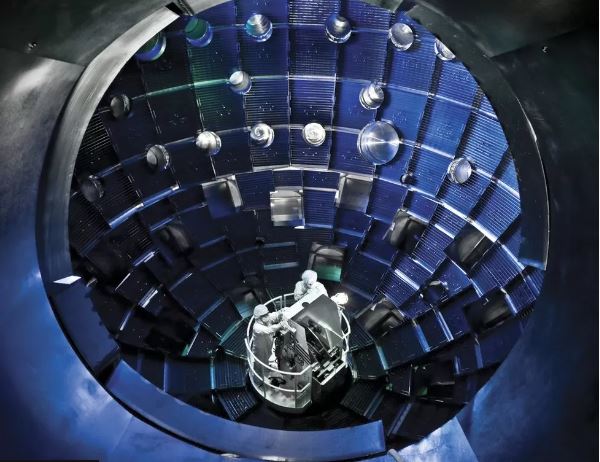
The experiment took place at the National Ignition Facility at the Lawrence Livermore National Laboratory (LLNL) in California.

LLNL director Dr Kim Budil said: “This is a historic achievement… over the past 60 years thousands of people have contributed to this endeavour and it took real vision to get us here.”

Nuclear fusion is described as the “holy grail” of energy production. It is the process that powers the Sun and other stars.

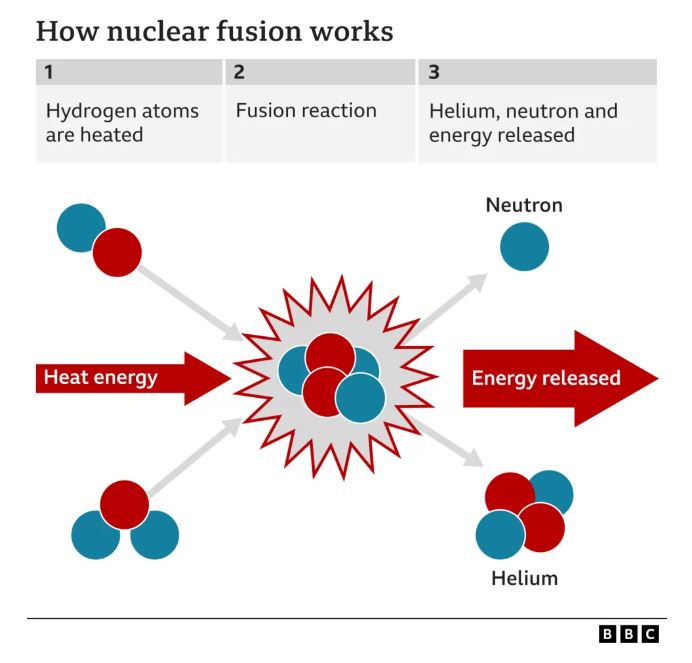
It works by taking pairs of light atoms and forcing them together – this “fusion” releases a lot of energy.

It is the opposite of nuclear fission, where heavy atoms are split apart. Fission is the technology currently used in nuclear power stations, but the process also produces a lot of waste that continues to give out radiation for a long time. It can be dangerous and must be stored safely.

Nuclear fusion produces far more energy, and only small amounts of short-lived radioactive waste. And importantly, the process produces no greenhouse gas emissions and therefore does not contribute to climate change.

But one of the challenges is that forcing and keeping the elements together in fusion requires very high temperatures and pressures. Until now, no experiment has managed to produce more energy than the amount put in to make it work.

How close is a fusion-powered future?

The amount of energy they’ve generated in this experiment is tiny – just enough to boil a few kettles. But what it represents is huge.

The promise of a fusion-powered future is one step closer. But there’s still a long way to go before this becomes a reality.

This experiment shows that the science works. Before scientists can even think about scaling it up, it needs to be repeated, perfected, and the amount of energy it generates will have to be significantly boosted.

This experiment has cost billions of dollars – fusion does not come cheap. But the promise of a source of clean energy will certainly be a big incentive for overcoming these challenges.

The National Ignition Facility in California is a $3.5bn (£2.85bn) experiment.

It puts a tiny amount of hydrogen into a capsule the size of a peppercorn.

Then a powerful 192-beam laser is used to heat and compress the hydrogen fuel.

The laser is so strong it can heat the capsule to 100 million degrees Celsius – hotter than the centre of the Sun, and compress it to more than 100 billion times that of Earth’s atmosphere.

Under these forces the capsule begins to implode on itself, forcing the hydrogen atoms to fuse and release energy.

On announcing the breakthrough Dr Marvin Adams, deputy administrator for defense programs at the US National Nuclear Security Administration, said that the laboratory’s lasers had input 2.05 megajoules (MJ) of energy to the target, which had then produced 3.15 MJ of fusion energy output.

How close is a fusion-powered future? The amount of energy they've generated in this experiment is tiny - just enough to boil a few kettles. But what it represents is huge. The promise of a fusion-powered future is one step closer. But there's still a long way to go before this becomes a reality. This experiment shows that the science works. Before scientists can even think about scaling it up, it needs to be repeated, perfected, and the amount of energy it generates will have to be significantly boosted. This experiment has cost billions of dollars - fusion does not come cheap. But the promise of a source of clean energy will certainly be a big incentive for overcoming these challenges. Presentational grey line The National Ignition Facility in California is a $3.5bn (£2.85bn) experiment. It puts a tiny amount of hydrogen into a capsule the size of a peppercorn. Then a powerful 192-beam laser is used to heat and compress the hydrogen fuel. The laser is so strong it can heat the capsule to 100 million degrees Celsius - hotter than the centre of the Sun, and compress it to more than 100 billion times that of Earth's atmosphere. Under these forces the capsule begins to implode on itself, forcing the hydrogen atoms to fuse and release energy. On announcing the breakthrough Dr Marvin Adams, deputy administrator for defense programs at the US National Nuclear Security Administration, said that the laboratory's lasers had input 2.05 megajoules (MJ) of energy to the target, which had then produced 3.15 MJ of fusion energy output.
How nuclear fusion energy works - Source: BBC

Dr Melanie Windridge, CEO of Fusion Energy Insights, told the BBC: “Fusion has been exciting scientists since they first figured out what was causing the Sun to shine. These results today really put us on the path to the commercialisation of the technology.”

Jeremy Chittenden, professor of plasma physics and co-director of the Centre for Inertial Fusion Studies at Imperial College London, called it “a true breakthrough moment”.

“It proves that the long sought-after goal, the ‘holy grail’ of fusion, can indeed be achieved,” he said.

This has been the sentiment echoed by physicists globally, who praised the work of the international science community.

Prof Gianluca Gregori, Professor of Physics at the University of Oxford, said: “Today’s success rests upon the work done by many scientists in the US, UK and around the world. With ignition now achieved, not only fusion energy is unlocked, but also a door is opening to new science.”

On the question of how long before we could see fusion being used in power stations, Dr Budil, the LLNL director, said there were still significant hurdles but that: “with concerted efforts and investment, a few decades of research on the underlying technologies could put us in a position to build a power plant”.

This is progress from when scientists used to say 50-60 years in answer to that question.

One of the main hurdles is getting costs down and scaling up the energy output.

The experiment was only able to produce enough energy to boil about 15-20 kettles and required billions of dollars of investment. And although the experiment got more energy out than the laser put in, this did not include the energy needed to make the lasers work – which was far greater than the amount of energy the hydrogen produced.


Source: BBC 

(Visited 22 times, 1 visits today)
Sri Lanka sets record straight on Apparel export remittances and conversions Previous: Governor, Central Bank of Sri Lanka sets record straight on Apparel export remittances & conversions
Everything You Need to Know About 5G Technology What is 5G? Next: Everything You Need to Know About 5G Technology

Comments are closed.

Recent Posts

  • Why Sri Lanka Must Accelerate Its E-Lottery Transition
  • Why Unleashing the Digital Economy Should Be Sri Lanka’s Top Priority
  • Digital Transformation of Lottery to e-Lottery Models
  • The Role of AI in Shaping the Future of Public Relations
  • Sri Lanka at a Crossroads: From Devastation to a New Era of Resilience
  • Sri Lanka in the Wake of the Cyclone, “Ditwah” : A Nation Counting Its Losses
  • On the Ground at the National AI Expo & Conference: Key Announcements & Day 1 Learnings
  • Sri Lanka Charts a Bold AI Future with First National AI Expo & Conference
  • Listening → Lead → Leadership: Why Sri Lanka’s Politics Needs Empathy Now
  • Stand Against the Fake: A Call for Truth, Accountability and Civic Courage

Subscribe for Newsletter

Loading

  • Facebook
  • Twitter
  • YouTube
  • LinkedIn
  • Search

PRMinds Business Journal

PRMinds Business Journal is common place to view all business & economic related news in one page.

Categories

  • Economy
  • Industries
  • Technology
  • Impacts
  • Invest SL
  • Research
  • CORPORATE

Recent Posts

  • Why Sri Lanka Must Accelerate Its E-Lottery Transition
  • Why Unleashing the Digital Economy Should Be Sri Lanka’s Top Priority
  • Digital Transformation of Lottery to e-Lottery Models
  • The Role of AI in Shaping the Future of Public Relations
  • Sri Lanka at a Crossroads: From Devastation to a New Era of Resilience

Contact Us

Call Us :

+94 716 837 660

Email :

prminds@gmail.com

Copyright © 2024 PRMinds Business Journal
  • Home
  • About
  • Contact
Close Search Window
↑

Contact Us